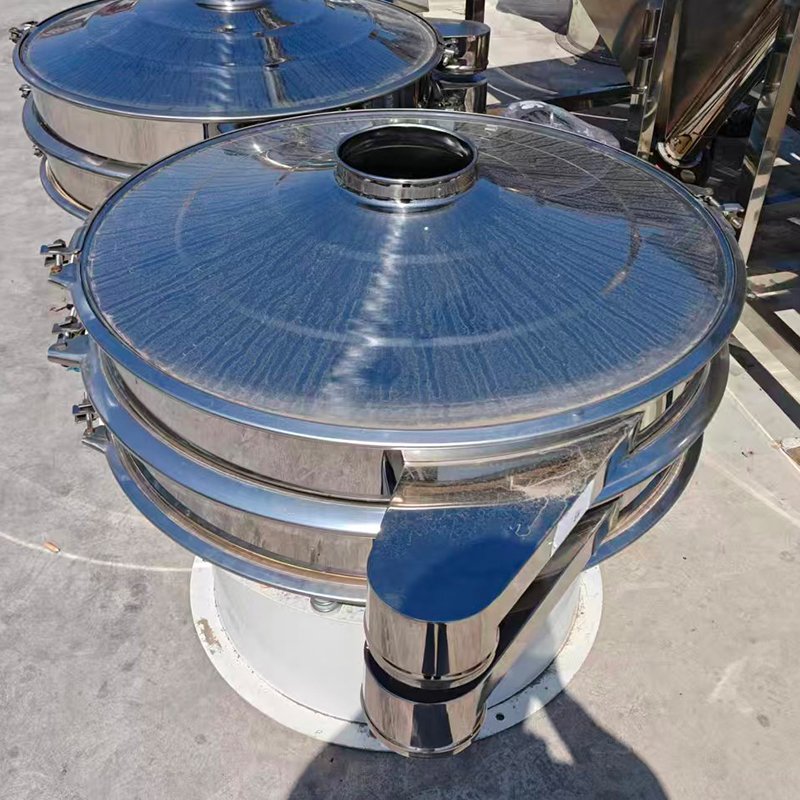
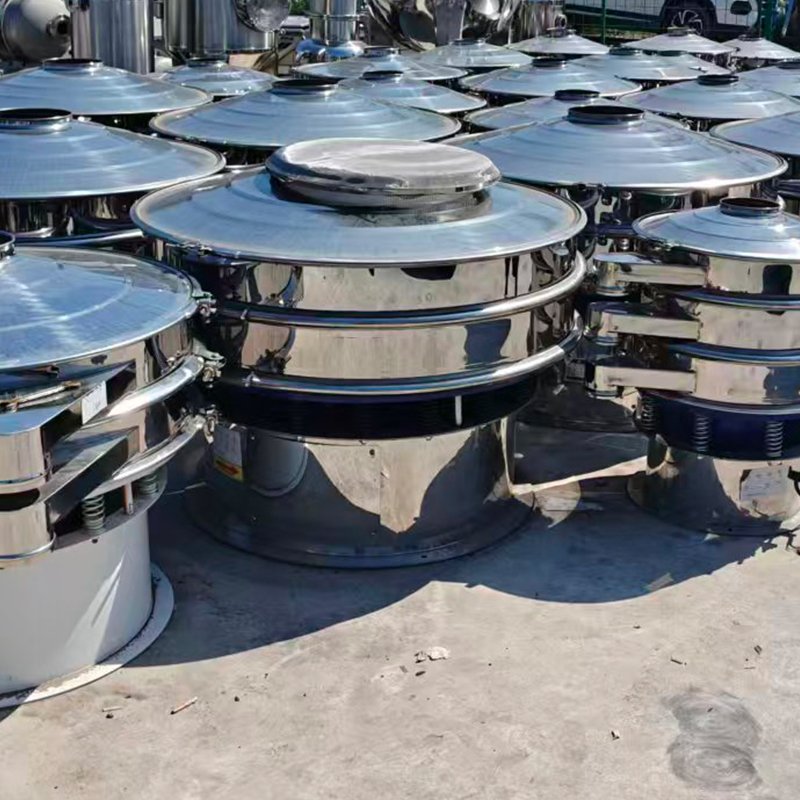
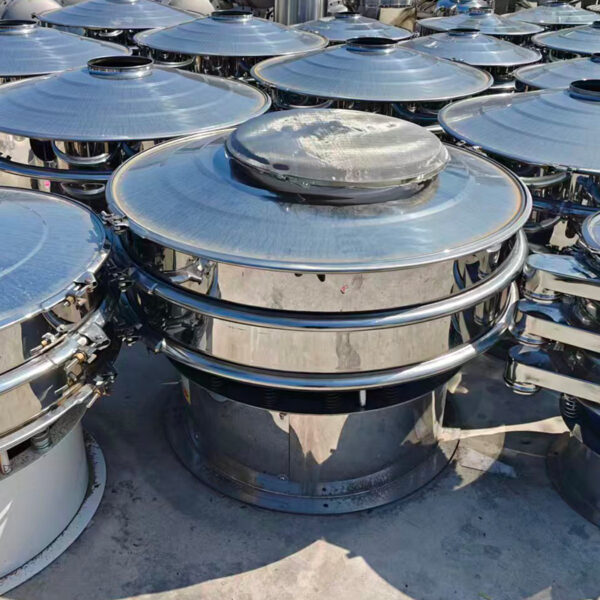
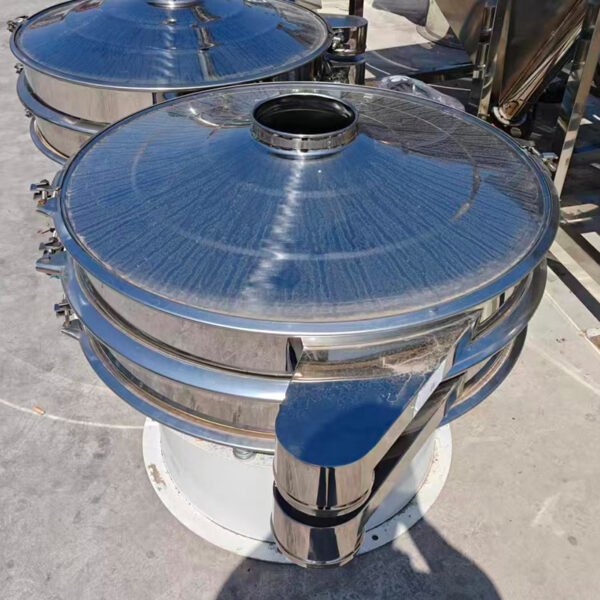
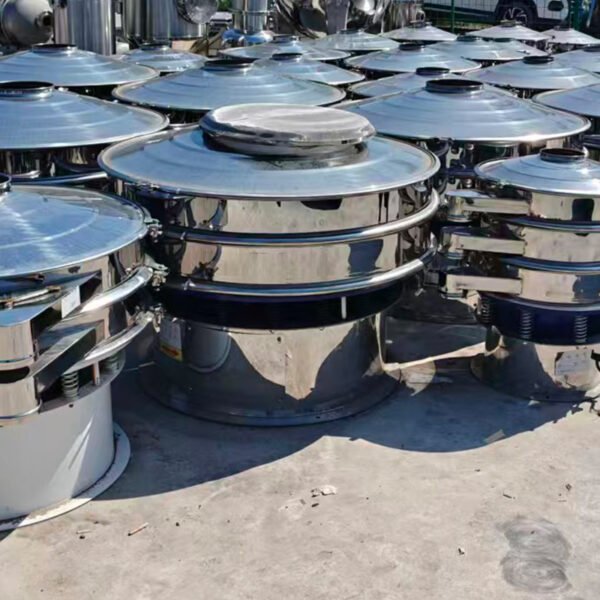
Working principle:
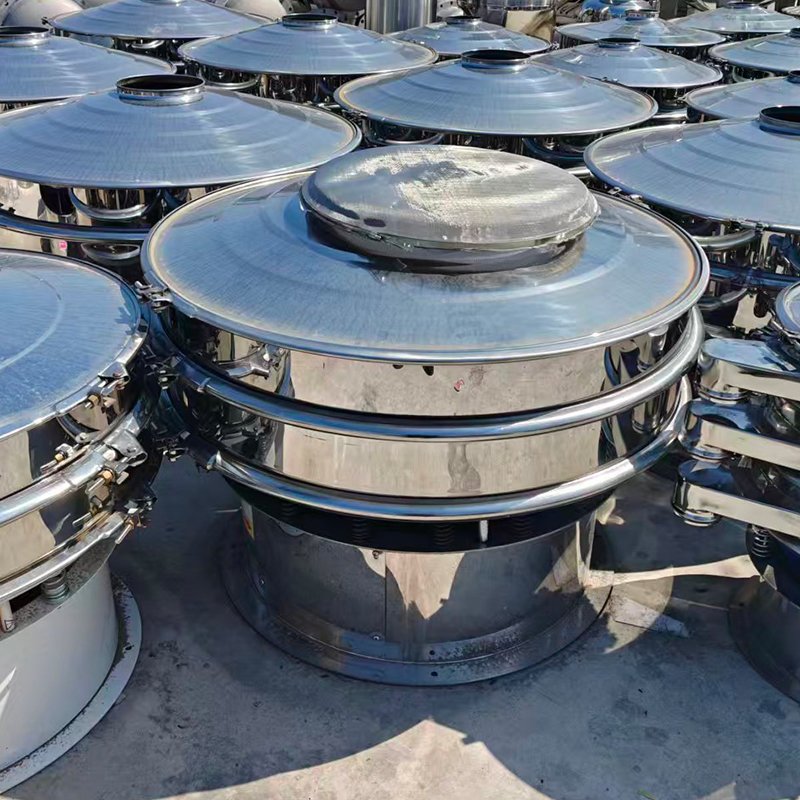
The core power of a circular vibrating screen comes from a vibration motor (or exciter), and its working logic is based on “inertial vibration + circular trajectory screening”:
Power drive: When the vibration motor (usually installed on the top or side of the screen box) operates, the eccentric blocks at both ends rotate to generate centrifugal inertial force, driving the screen box to perform high-frequency, small-amplitude circular vibration (the vibration trajectory is a perfect circle or ellipse).
Material movement: The materials to be screened enter from the feed inlet above the screen box. Under the action of circular vibration, they perform a composite movement of “jumping + spiral” along the screen surface — sliding downward along the inclined direction of the screen surface while bouncing up and down due to vibration.
Classification and separation: During the movement, materials with particle diameters smaller than the screen holes (“undersize materials”) pass through the screen mesh and fall to the lower discharge outlet; materials with particle diameters larger than the screen holes (“oversize materials”) continue to move along the screen surface and are discharged from the upper discharge outlet, ultimately achieving the classification of materials with different particle sizes or the removal of impurities.
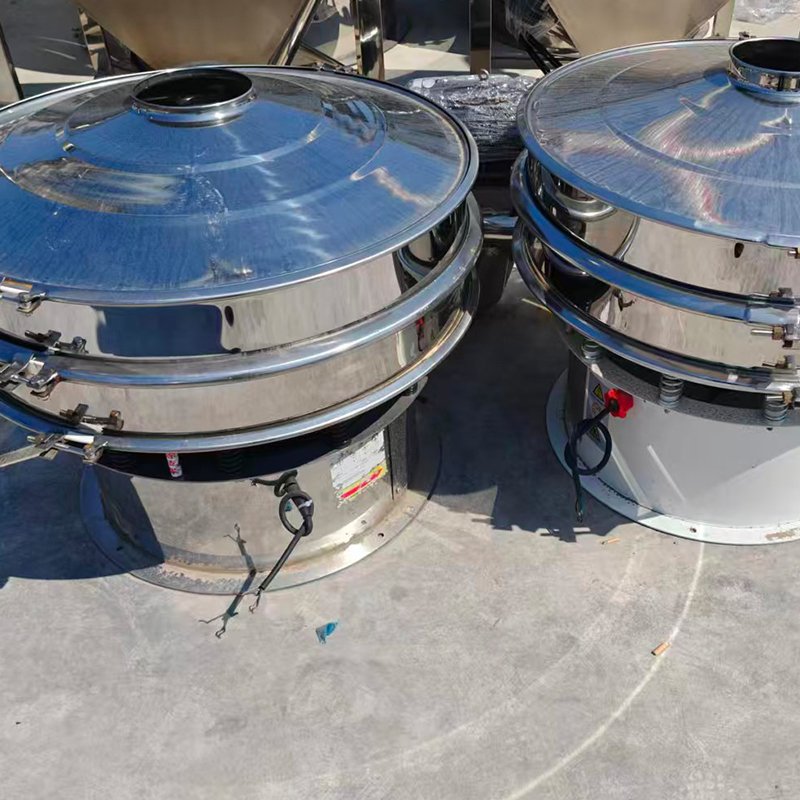
Structural composition:
The circular vibrating screen has a compact structure and is mainly composed of five core components: the screen box, vibration motor (vibrator), screen mesh, damping system, and frame.
· screen box – Rectangular/trapezoidal box welded with steel plates
· Vibration motor / Vibrator – Motor main body + adjustable eccentric blocks at both ends (or external vibrator + transmission device)
· screen mesh – Metal woven mesh, punching mesh, polyurethane mesh, nylon mesh, etc. (selected as needed)
· Shock absorption system – Rubber springs, steel springs, or air springs (installed between the screen box and the frame)
· rack – Steel section welded frame (some small equipment uses an integrated frame)
Core Features:
The advantages of the circular vibrating screen stem from its “circular vibration trajectory” and structural design, with the main characteristics including:
· High screening efficiency
· High classification accuracy
· Wide adaptation of materials
· Strong environmental adaptability
· Stable operation and easy maintenance
· Low noise
Application fields:
Circular vibrating screens have strong adaptability and meet the core screening needs of multiple industries.
Mining / Metallurgy: classification of iron ore, copper ore, and gold sand; particle size screening of sinter and coke; impurity removal and recovery of steel slag and furnace slag
Building materials industry、Chemical industry、Environmental protection industry