
Structural Composition
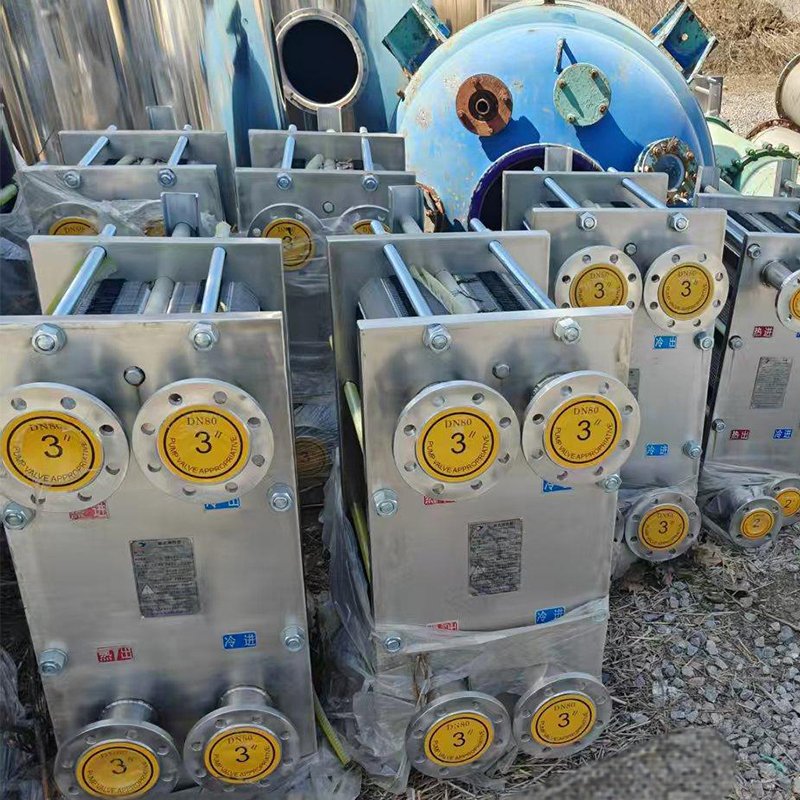
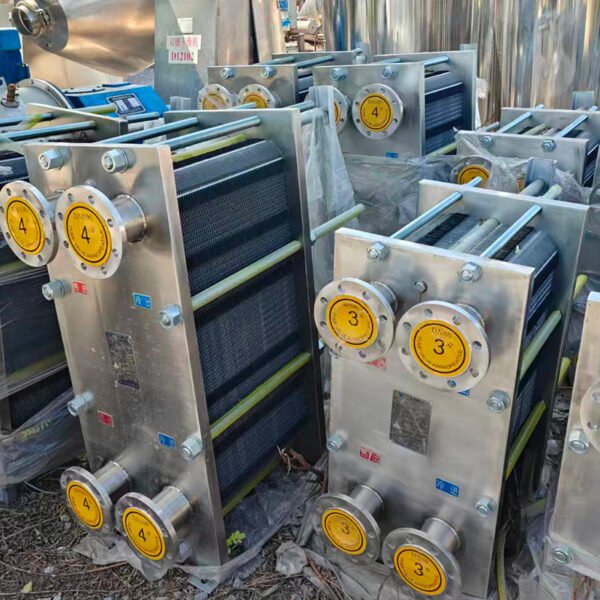
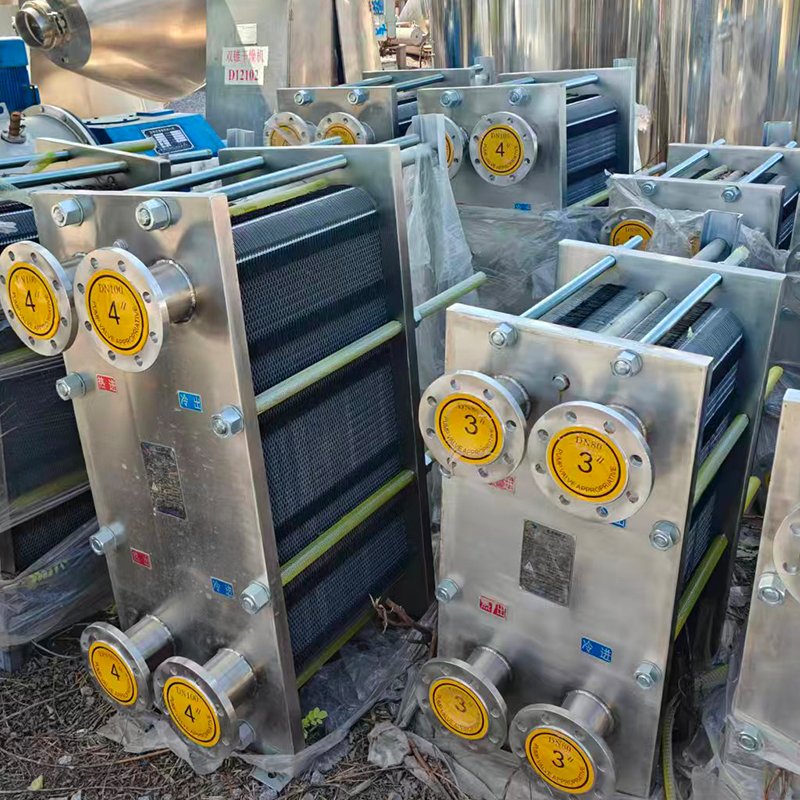
Plate: It is the main heat exchange component, usually made of metals such as stainless steel and titanium, with various corrugated shapes, such as herringbone, horizontal straight, and nodular shapes. The corrugated design can increase fluid disturbance and improve heat transfer efficiency.
Gasket: Used for sealing between plates to prevent fluid leakage. The material is selected based on the characteristics of the medium, operating temperature, pressure, etc. Common materials include rubber, asbestos fiber, etc.
Frame: It includes a fixed plate, a movable plate, a pressure plate, guide rods, and fastening bolts, etc. It is used to fix the plates and sealing gaskets, so that stable flow channels are formed between the plates. The compression degree of the plates can be adjusted through the compression bolts to ensure tightness.
Inlet and outlet nozzles: used to connect external pipelines, allowing cold and hot fluids to flow into and out of the heat exchanger.
Working Principle
Plate heat exchangers work based on the principle of heat conduction. Two types of fluids, cold and hot, flow in the channels on either side of the plates respectively, and heat is transferred from the high-temperature fluid to the low-temperature fluid through the plates. The corrugated design of the plates causes the fluid to continuously generate turbulence during the flow process, which increases the contact area and contact time between the fluids, thereby improving the heat exchange efficiency.
Features
Advantages: High heat transfer coefficient, 3-5 times higher than that of tubular heat exchangers; Compact structure with a small floor area, only about 1/3 of that of tubular heat exchangers; Great operational flexibility, as the heat transfer area and process combination can be changed by increasing or decreasing the number of plates or rearranging them; Wide application range, capable of handling various media; Low metal consumption, small heat loss, convenient installation, inspection, disassembly and cleaning, and long service life.
Disadvantages: The sealed perimeter is long, leading to a high risk of leakage; the temperature resistance of the gasket is not high, generally not exceeding 150°C; the load-bearing capacity is low, with a limited maximum pressure it can withstand; it is not easy to handle scaling and blocked materials, and the gap between plates is small, which is easily blocked by media containing particles, fibers, or high viscosity; the processing capacity is relatively small.
Classification
According to structural forms: they can be divided into detachable plate heat exchangers, welded plate heat exchangers, spiral plate heat exchangers, plate coil heat exchangers, etc. Among them, welded plate heat exchangers can be further subdivided into semi-welded plate heat exchangers, fully welded plate heat exchangers, plate-and-shell heat exchangers, brazed plate heat exchangers, etc.
According to process applications: they can be divided into plate heaters, plate coolers, plate condensers, plate preheaters, etc.
According to flow combinations: they can be divided into single-pass plate heat exchangers and multi-pass plate heat exchangers.
According to the flow direction of the two media: they can be divided into cocurrent plate heat exchangers, countercurrent plate heat exchangers, and cross-flow plate heat exchangers.
Application fields
It is widely used in industries such as chemical engineering, petroleum, food, pharmaceuticals, papermaking, metallurgy, refrigeration, and HVAC. For example, in the chemical industry, it is used for heat exchange of various chemicals; in the food industry, it is used for heating and cooling materials; in the pharmaceutical industry, it is used for heat exchange of materials to ensure precise temperature control, etc.