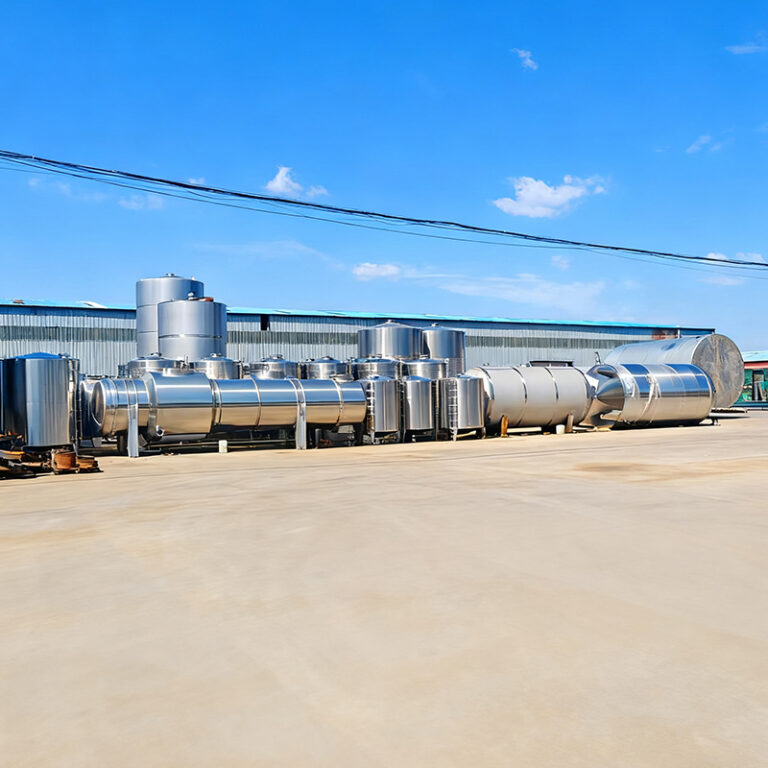
In the production processes of chemical, pharmaceutical, food and other industries, reactors are key equipment for realizing core processes such as material chemical reactions, mixing, and heating. Stainless steel, with its characteristics of corrosion resistance, easy cleaning, and high strength, has become the mainstream choice for reactors. This article will detail the practical knowledge of stainless steel reactors from three core dimensions: selection, maintenance, and application, to help enterprises improve equipment utilization and production safety.
I. Avoiding Pitfalls in Selection: 5 Core Parameters Determine Device Compatibility
The selection of stainless steel reactors directly affects production efficiency and product quality. It is necessary to combine process requirements and focus on the following key parameters to avoid ‘mismatch’ risks:
1.Material selection: 304 vs 316L, matching corrosion environment as needed
The most commonly used materials for stainless steel reactors are 304 stainless steel and 316L stainless steel. If the production process involves neutral or weakly corrosive materials (such as sucrose solutions in the food industry or ordinary pharmaceutical liquids in the pharmaceutical industry), 304 stainless steel can meet the requirements with relatively lower cost; if it involves strongly corrosive media (such as acid-base solutions in the chemical industry or organic solvents in the pharmaceutical industry), 316L stainless steel should be selected. It contains molybdenum, which has more than 30% stronger resistance to intergranular corrosion and pitting than 304, and also meets strict standards such as GMP and FDA. When selecting the model, it is necessary to require the manufacturer to provide material test reports to avoid substandard materials being passed off as good ones.
2.Volume calculation: Determine based on ‘actual production capacity + reserved space’
The reactor volume needs to be calculated in combination with the daily production batch and process cycle. For example, if 1000L of material reaction needs to be completed daily, and the single reaction cycle is 2 hours (including heating up, reaction, and cooling down), with 8 hours of work per day, equipment with an effective volume of 300-400L should be selected (the single feeding amount is about 70%-80% of the effective volume, reserving space for material boiling or stirring). At the same time, the workshop layout should be considered to ensure that the distance between the equipment and pipelines, operation tables is no less than 0.8 meters, for convenient operation and maintenance.
3.Mixing system: Select the type and speed according to the material properties
The mixing system directly affects the uniformity of the reaction. It needs to be selected according to the viscosity of the material and the process requirements.
4.Pressure and temperature parameters: meet the process limit requirements
The design pressure and temperature of the reactor must cover the extreme values of actual production (with a 10%-20% safety margin reserved). For example, if the actual pressure requirement for high-pressure synthesis reactors in the chemical industry is 0.8MPa and the temperature is 180℃, equipment with a design pressure ≥1.0MPa and a design temperature ≥200℃ should be selected. At the same time, attention should be paid to the heating method: electric heating is suitable for scenarios with small to medium volume (≤500L) and high temperature control accuracy requirements (±1℃); steam heating is suitable for large-volume (≥1000L) production that requires rapid heating, with lower energy consumption.
5.Sealing method: Ensuring no leakage and process cleanliness
Sealing systems are divided into mechanical seals and packing seals.